Springe zum Inhalt

Previous Project

A modern and practical approach to judicial training for court staff and bailiffs in Europe

Under the Justice Programme 2021-2027, ERA implemented a new training project for court staff and bailiffs in partnership with the European Judicial Training Network (EJTN), the Belgian Judicial Training Institute (IGO-IFJ), the Bulgarian National Institute of Justice (NIJ), the Romanian National School of Clerks (NSC) and with the support of 13 national judicial training institutions and the European Union of Judicial Officers (UEHJ).

Recent studies and reports show that court staff and bailiffs receive insufficient training in EU law. Building on the knowledge and experience gained from the implementation of previous court staff training projects, and following the recommendations made in the “Study on the training needs of court staff on EU law in the EU”, ERA and the project consortium tackled the deficiencies of court staff and bailiffs’ training by adopting a modern and practical approach to EU judicial training and by developing coherent and innovative training packages for future use.

Brochure
Brochure

The project dealt with EU civil and criminal law matters relevant for the judicial work of court staff and bailiffs as well as digitalisation. To better accommodate the various training needs of the target groups, reflecting different levels of prior knowledge and experience in applying EU instruments, the legal seminars were offered at both basic and advanced level. Some activities offered legal English language training parallel to legal training thus enhancing the linguistic skills of court staff and bailiffs in legal areas with added practical value. To make the activities more accessible and inclusive, they were offered in various formats (face-to-face, hybrid, online).

The project covered the following instruments:

The training materials for the provision of legal training mainly consisted of case studies covering the abovementioned EU instruments, including the case scenario, suggested solution as well as the necessary background materials and methodological advice for their implementation.

For the provision of language training, two manuals with language exercises were developed by a linguistic expert. The exercises focused on developing four skills: reading, writing, speaking and listening.

The pan-European legal seminars focused on specific aspects of cross-border civil and criminal law matters. They were held in English and were hosted by the consortium in various EU Member States. A fair balance between the topics of the seminars was sought – five seminars dealing with EU civil law, five with EU criminal law and one with legal writing. They were offered at two different levels, introductory and advanced.

Each event had a duration of 1.5 days and was attended by max. 30 participants from different EU Member States.

2023
Brussels
5-6 June 2023
Programme
Introductory seminar
Cross-border Civil Litigation: Facilitating the Handling of Cross-border Cases
Madrid
19-20 October 2023
Programme
Advanced seminar
Trier & Online
7-8 December 2023
Programme
Introductory seminar
2024
Sofia
14-15 March 2024
Programme
Introductory seminar
Vienna
21-22 November 2024
Programme
Advanced seminar
2025
Trier
30-31 January 2025
Programme
Legal writing
2023
Bucharest
4-5 May 2023
Programme
Introductory seminar
Zagreb
9-10 November 2023
Programme
Advanced seminar
2024
Lublin
1-2 February 2024
Programme
Introductory seminar
Trier & Online
6-7 June 2024
Programme
Introductory seminar
Vilnius
10-11 October 2024
Programme
Advanced seminar

In parallel to the organisation of the purely legal seminars, a series of ten English language training events was implemented (five focusing on EU civil law and five on EU criminal law). The legal English training events were conducted by professional linguists together with legal experts. All experts had at their disposal the training materials (case studies and linguistic manuals) specially developed for the implementation of these training events.

Each event had a duration of 2.5 days and was addressed to maximum 24 court staff and bailiffs from various EU Member States.

2023
Trier
25-27 September 2023
Programme
2024
Brussels
5-7 February 2024
Programme
Trier
12-14 June 2024
Programme
Brussels
18-20 September 2024
Programme
Online
2-4 December 2024
Programme
2023
Trier
8-10 May 2023
Programme
Online
19-21 June 2023
Programme
Brussels
29 November - 1 December 2023
Programme
2024
Brussels
17-19 April 2024
Programme
Trier
13-15 November 2024
Programme
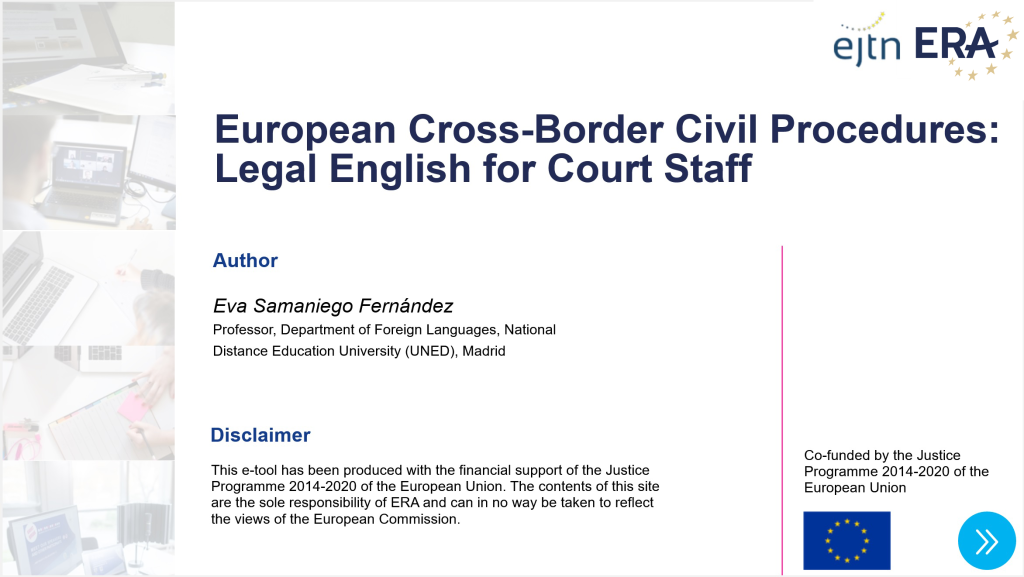
e-Tool on European Cross-border Civil Procedures: Legal English for Court Staff
e-Tool on European Criminal Law: Legal English for Court Staff

All training materials are freely available and downloadable.

Legal package

Six sets of case studies on selected EU legal instruments in cross-border civil litigation have been developed for the training of court staff and bailiffs. The materials focus on tasks relevant to the work of court staff and bailiffs. Some more advanced questions are provided for those who already have a basic understanding of these European rules. Each case study includes the case scenario, the proposed solution and some methodological advice on how to apply it.

Linguistic package

For the provision of language training, a manual with language exercises was developed by a linguistic expert. The exercises focus on developing four skills: reading, writing, speaking and listening.

Legal Package

Seven modules on selected EU legal instruments in judicial cooperation in criminal matters in the EU have been developed for the training of court staff and bailiffs. The materials focus on tasks relevant to the work of court staff and bailiffs. Each package includes a presentation on the topic together with practical exercises, the proposed solution, and some methodological advice on how to apply it.

Linguistic package

For the provision of language training, a manual with language exercises was developed by a linguistic expert. The exercises focus on developing four skills: reading, writing, speaking and listening.
Instructions to use the linguistic manual (for trainers and individual users).
Linguistic manual with answer key.

European_Commission

Co-funded by  the European Union